I Built a System That Checks if ChatGPT Knows Your Brand. Most Businesses Score 0%. If AI does not know you exist, your customers won't either. Here's why — and how to fix it.

The Experiment
A few weeks ago, I asked ChatGPT a simple question:
"What are the best AI sales tools for e-commerce?"
I got a list. Intercom. Drift. Tidio. ManyChat. HubSpot.
My own product — CatyAI — was not on the list.
I asked Perplexity the same question. Same result. I asked Claude. Same result. I asked Google Gemini. Same result.
CatyAI has real clients. Real results. A dental clinic that generated 37 patients in 5 days. An e-commerce store that added 5,800 EUR in revenue in 10 days. A digital agency that went from zero clients to 78 qualified leads.
But AI does not know any of that.
So I built a system to understand why.
AIVisibilityMonitor: What It Does
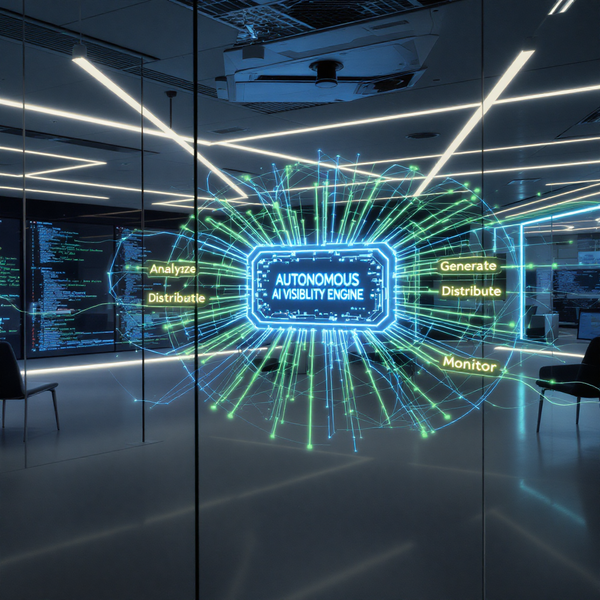
I created a monitoring tool that checks how AI systems perceive any brand. It queries multiple AI models with relevant industry questions and analyzes whether the brand appears in the responses.
I tested it on two of my own platforms:
CatyAI (catyai.io) — AI sales conversion engine Ahauros AEOS (ahauros.io) — AI economic operating system
The result: 0% AI visibility for both.
Not low. Zero.
ChatGPT does not mention them. Perplexity does not cite them. Claude does not recommend them. Google AI Overviews does not reference them.
These are real products with real users generating real revenue. And to AI, they do not exist.
Why AI Does Not Know Your Brand
When ChatGPT or Perplexity generates an answer, it draws from sources it has "seen" during training or can access through search. These sources follow a very specific pattern:
Sources AI trusts most:
- Wikipedia
- Major publications (TechCrunch, Forbes, Wired)
- Reddit (high upvote threads)
- Stack Overflow
- GitHub (for tech products)
- Medium (high-engagement articles)
- Quora (top answers)
- Product Hunt (popular launches)
- G2, Capterra (review platforms)
- Official documentation sites
Sources AI barely sees:
- Your company website (unless heavily linked)
- Your blog (unless syndicated)
- Your LinkedIn posts
- Your Facebook ads
- Your local press coverage
The pattern is clear. AI systems build their knowledge from platforms where information is discussed, validated, and cross-referenced by communities.
If your brand exists only on your own website, AI literally cannot see you.
The GEO Score: 8 Dimensions of AI Visibility
To quantify this, I developed a scoring system called GEO Score (Generative Engine Optimization Score). It measures brand visibility across 8 dimensions:
1. Source Diversity Score (0-100)
How many different platforms mention your brand? A brand mentioned on 1 site scores 5. A brand mentioned on 20 different platforms scores 80+.
2. Citation Frequency Score (0-100)
How often does your brand appear when AI is asked relevant questions? Tested across 50 industry-relevant queries.
3. Entity Recognition Score (0-100)
Does the AI recognize your brand as a distinct entity? Can it describe what you do, who founded you, what your product does?
4. Sentiment Score (0-100)
When your brand is mentioned, is the context positive, neutral, or negative? AI systems prefer to cite sources with positive community sentiment.
5. Freshness Score (0-100)
How recent are the mentions? AI with web search capabilities prioritize recent content. A brand mentioned heavily in 2023 but silent in 2026 scores low.
6. Authority Score (0-100)
Are the sources that mention you authoritative? A mention on TechCrunch weighs more than a mention on a random blog.
7. Cross-Reference Score (0-100)
Do multiple independent sources say the same thing about you? Consistent information across sources builds AI confidence.
8. Structured Data Score (0-100)
Does your website use Schema markup, FAQ structured data, and machine-readable content? This determines whether AI can parse your site directly.
Total GEO Score = weighted average of all 8 dimensions.
When I ran CatyAI and Ahauros through this scoring:
| Dimension | CatyAI | Ahauros |
|---|---|---|
| Source Diversity | 12 | 8 |
| Citation Frequency | 0 | 0 |
| Entity Recognition | 15 | 10 |
| Sentiment | N/A | N/A |
| Freshness | 20 | 15 |
| Authority | 5 | 5 |
| Cross-Reference | 5 | 3 |
| Structured Data | 30 | 25 |
| Total GEO Score | 12/100 | 9/100 |
For context, established competitors score:
| Brand | GEO Score |
|---|---|
| Intercom | 85+ |
| Drift | 78+ |
| Tidio | 72+ |
| HubSpot | 92+ |
The gap is massive. And it has nothing to do with product quality.
SEO vs. GEO: The Critical Difference
SEO (Search Engine Optimization) optimizes for Google's ranking algorithm.
- Goal: appear higher in search results
- Method: keywords, backlinks, page speed, content quality
- Result: clicks from Google
GEO (Generative Engine Optimization) optimizes for AI answer engines.
- Goal: be cited as a source in AI-generated answers
- Method: source diversity, structured data, entity building, community presence
- Result: brand mentions in ChatGPT, Perplexity, Claude, Google AI Overviews
You can rank number one on Google and still have zero AI visibility.
And increasingly, users are not going to Google at all. They are asking ChatGPT. They are using Perplexity. They are relying on AI Overviews.
If the AI does not know your brand, you are invisible to a growing percentage of potential customers.
Brand Seeding: The Solution
Brand Seeding is the process of systematically creating presence on the platforms that AI systems use as sources.
It is not spam. It is not fake reviews. It is legitimate, valuable content published across the platforms that AI trusts.
A Brand Seeding strategy includes:
Medium — Publish case studies, technical articles, and industry analysis. Medium articles are heavily indexed by AI systems.
Reddit — Participate in relevant subreddits (r/SaaS, r/startups, r/ecommerce). Share experiences, data, and insights. Reddit threads with high engagement are a primary AI training source.
Quora — Answer relevant questions with detailed, data-backed responses. Quora answers are frequently cited by Perplexity and ChatGPT.
Product Hunt — Launch and maintain an active product page. Product Hunt is a key source for AI systems when recommending software.
GitHub — For tech products, open-source components or documentation repositories create strong entity signals.
Substack / Hashnode — Technical blogs that build authority in your niche.
Industry directories — SaaSHub, G2, Capterra, AlternativeTo, Futurepedia, and domain-specific directories.
Wikipedia — If your company meets notability criteria, a Wikipedia page is the single strongest entity signal for AI.
The key principle: every platform you publish on creates a new "vote" for your brand in the AI's knowledge graph.
The Compound Effect
Here is what makes GEO powerful:
Month 1: You publish 5 articles on Medium, 10 Quora answers, 3 Reddit threads, and list on 5 directories.
AI visibility: still near zero. But the seeds are planted.
Month 3: Your articles are indexed. Your Quora answers are getting upvotes. Your Reddit threads have engagement. Directories link to your site.
AI visibility: 15-25%. You start appearing in some AI answers.
Month 6: Cross-references accumulate. Multiple independent sources describe your product consistently. Your structured data is rich. Your entity profile is established.
AI visibility: 50-70%. AI systems now cite you alongside established competitors.
This is not a hack. It is a systematic process of building the same digital presence that major brands built over years — accelerated through strategic content placement.
What I Am Doing About It
After seeing the GEO scores for CatyAI and Ahauros, I started an aggressive Brand Seeding campaign:
- Published technical articles on Medium, Hashnode, and Substack
- Created detailed answers on Quora
- Shared real case studies on Reddit (without promotional framing)
- Listed on Product Hunt, SaaSHub, and multiple AI directories
- Added FAQ Schema and structured data to all product pages
- Created documentation that AI systems can parse
The goal is to go from a GEO Score of 12 to 70+ within 6 months.
I built automation for parts of this process. The system analyzes which platforms are missing, generates appropriate content for each platform, and monitors whether AI visibility improves over time.
The Uncomfortable Truth
SEO is not dying. But it is no longer enough.
In 2020, if you ranked on page one of Google, you won.
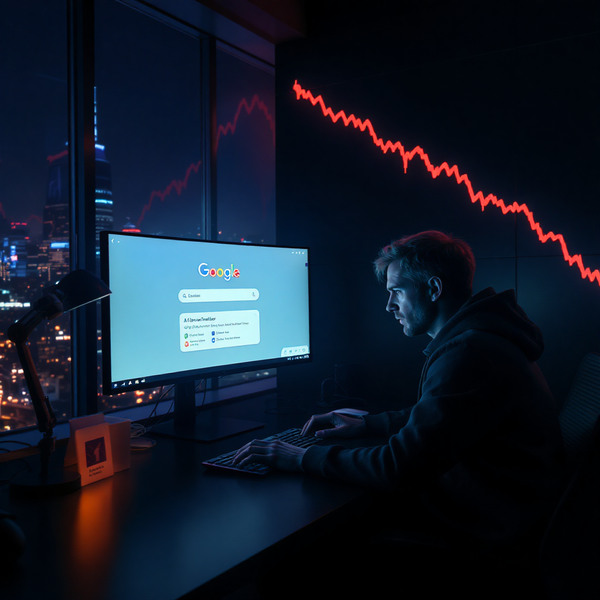
In 2026, you can rank on page one and still be invisible — because the user asked ChatGPT instead of Google, and ChatGPT recommended your competitor.
GEO is not optional anymore. It is the new battleground for brand visibility.
The businesses that start now will own the AI-generated answer space within 6-12 months. The ones that wait will wonder why their brand never appears when customers ask AI for recommendations.
The question is not whether AI will change how people discover products. It already has.
The question is whether AI knows your brand — or only your competitor's.
Check your own AI visibility: ask ChatGPT, Perplexity, and Claude about your industry. If your brand does not appear, your GEO Score is likely near zero.
Tags: ChatGPT, Artificial Intelligence, SEO, Startup, Marketing